
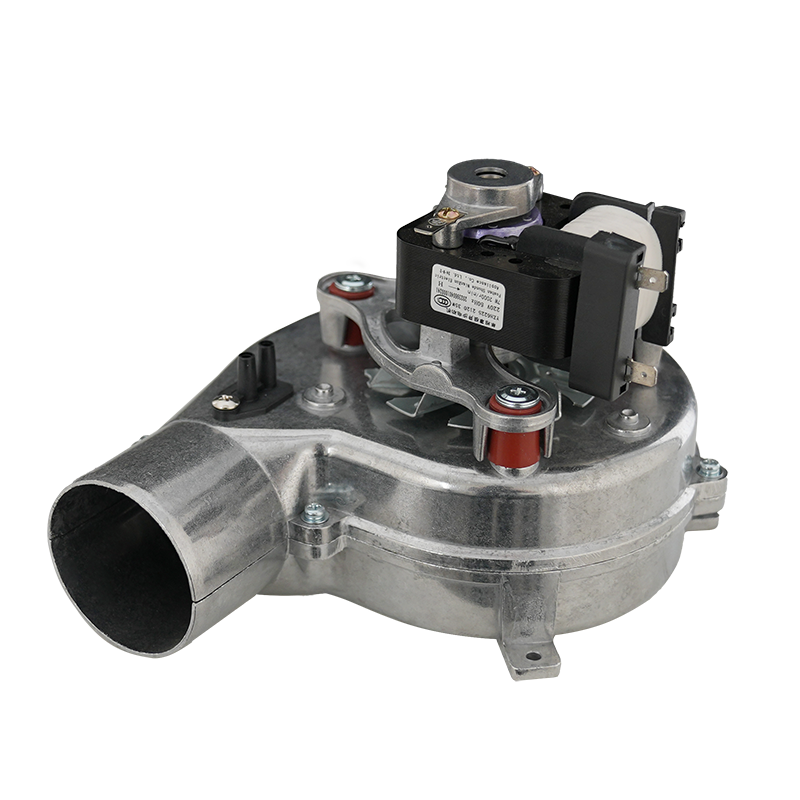
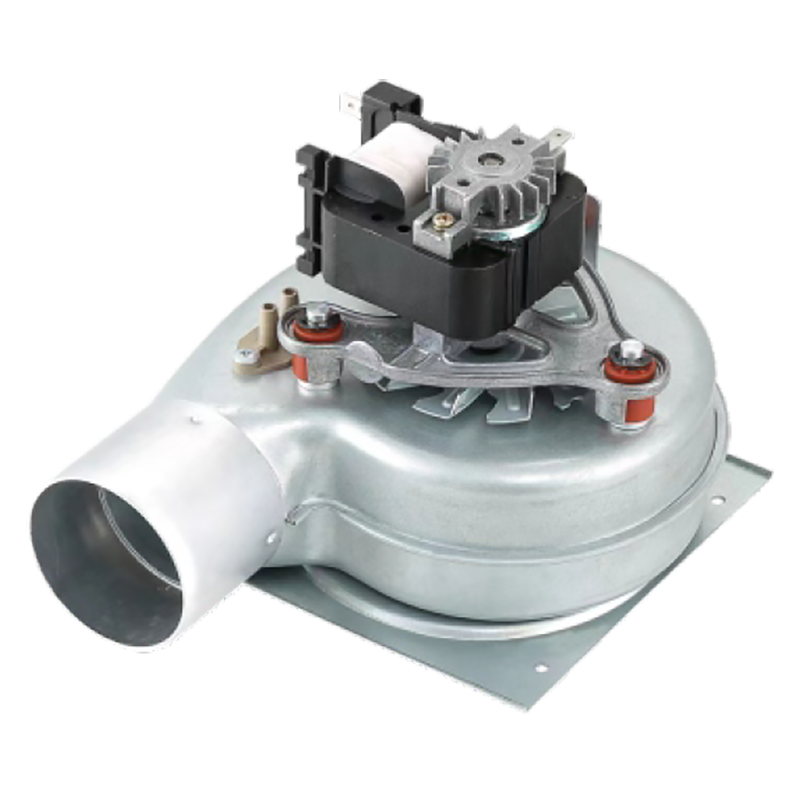
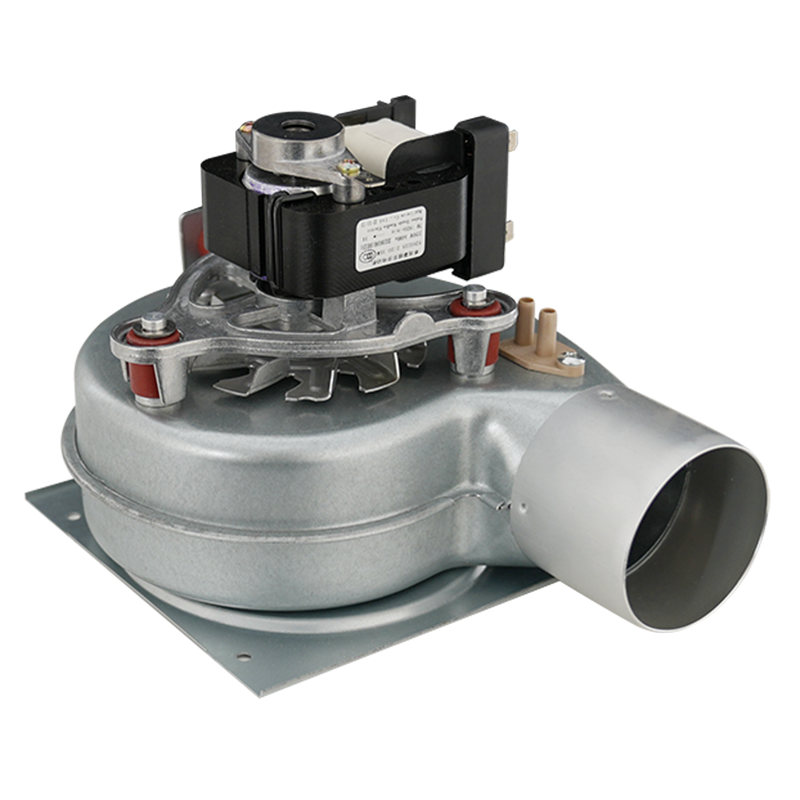
Mathematical Relationships Between Centrifugal Fan Parameters: There are clear mathematical relationships between the various parameters of a centrifugal fan, forming the theoretical basis for fan design, selection, and operation:
1) Relationship between airflow and velocity: The airflow (Q) is equal to the product of the velocity (V) and the duct cross-sectional area (S), i.e., Q = V × S. This relationship indicates that, for a given airflow, the velocity is inversely proportional to the duct cross-sectional area.
2) Relationship between total pressure, static pressure, and dynamic pressure: The total pressure (total pressure) is equal to the sum of the static pressure and the dynamic pressure, i.e., Pt = Pst + Pd. This relationship indicates that the total pressure of the fan consists of both static and dynamic pressure.
3) Centrifugal blower fan power calculation relationship: The blower power (N) is calculated based on parameters such as air volume (Q), air pressure (P), and blower and mechanical transmission efficiency (η). The basic formula is: N = K × (Q × P) / (3600 × η1 × η2 × 1000), where K is the motor capacity coefficient, η1 is the blower efficiency, and η2 is the mechanical transmission efficiency.
4) Centrifugal blower fan specific speed (ns) and impeller type relationship: Specific speed is an important parameter for selecting the blower type. The calculation formula is: ns = 5.54 × n × (Q^0.5) / (P^0.75), where n is the rotational speed (rpm), Q is the flow rate (m³/s), and P is the total pressure (Pa). Specific speed determines the impeller type: low specific speed (ns<30) uses radial blades, medium specific speed (30-80) mostly uses backward-curved blades, and high specific speed (>80) requires a forward-curved blade design.
5) Relationship between centrifugal blower fan speed and airflow, air pressure, and power: According to the similarity law, the airflow, air pressure, power, and speed of a centrifugal fan have the following relationships: Airflow is directly proportional to speed: Q1/Q2 = n1/n2; Air pressure is directly proportional to the square of speed: P1/P2 = (n1/n2)²; Power is directly proportional to the cube of speed: N1/N2 = (n1/n2)³
6) Relationship between centrifugal blower fan impeller diameter and speed: When the fan and motor are driven by a belt, the relationship between the fan speed, motor speed, and pulley diameter is: n1/n2 = d2/d1, where n1 and n2 represent the speeds of the fan and motor, respectively, and d1 and d2 represent the diameters of the pulleys of the fan and motor, respectively.
7) The effect of medium density on fan performance: When the medium density changes, the fan's airflow, air pressure, and power will change accordingly: Airflow constant: V = V0; Air pressure proportional to density: p = p0 × (ρ/ρ0); Power proportional to density: P = P0 × (ρ/ρ0)
8) The effect of temperature and pressure on fan performance: When atmospheric pressure and temperature change, the conversion relationships of fan performance parameters are as follows: Airflow constant: V = V0; Air pressure conversion: p = p0 × (pb × (273 + 20)) / (pb0 × (273 + t)); Power conversion: P = P0 × (pb × (273 + 20)) / (pb0 × (273 + t)). Where pb0 and pb are the atmospheric pressures under standard and actual operating conditions, respectively, and t is the actual operating temperature.
Similarity Laws and Their Applications
Similarity laws are important tools for centrifugal fan performance analysis and parameter conversion. They describe the performance relationships of the same fan at different speeds or sizes:
1) Expressions of Similarity Laws:
Airflow Relationship: Q1/Q2 = n1/n2 = D1/D2
Air Pressure Relationship: P1/P2 = (n1/n2)² = (D1/D2)²
Power Relationship: N1/N2 = (n1/n2)³ = (D1/D2)³
2) Application Scenarios of Similarity Laws:
When it is necessary to change the fan speed to adapt to system requirements, the airflow, air pressure, and power at the new speed can be predicted.
When it is necessary to select fans of different sizes, performance parameters can be converted according to similarity laws.
In fan performance testing and data processing, similarity laws can be used to convert performance data under test conditions to data under standard conditions. 3) Practical application of the similarity law: Suppose a fan operates at 1450 rpm with an air volume of 10000 m³/h, an air pressure of 1000 Pa, and a power of 4 kW. If the speed is increased to 2900 rpm, according to the similarity law, the new air volume will be 20000 m³/h (2 times), the new air pressure will be 4000 Pa (4 times), and the new power will be 32 kW (8 times).